Where to Find a Location Scout in NYC
Source: Peerspace
New York is a filmmaker’s dream. It teems with life and drama, and it’s filled with iconic landmarks. It also boasts an untold number of apartments, homes, restaurants, churches, stores, offices, and so on. Each of these landmarks and public space has its own stories, and all have its own unique appeal. Hello, NYC location scouting! Yes, it’s up to a location scout NYC based to help filmmakers discover the perfect location in the city for shooting a production.
Luckily, if you’ve come here for information about finding a location scout in NYC, you are definitely in the right place! As the largest online marketplace for peer-to-peer venue rentals, Peerspace has hundreds and hundreds of locations available in the City That Never Sleeps. With Peerspace, you can be your own location scout, with professional, one-of-a-kind venues that you can rent by the hour. Ahead, we’ll share more details about Peerspace locations and everything else you need to know about where to find a location scout in NYC.
First of all, what is a location scout?
Most scripts contain dozens of locations. A location scout’s job is to read a script, think about the script’s locations the way a director would, and then, using this mind-meld with the director, find the perfect locations for filming in the real world and secure them. A good location scout has a healthy sense of adventure, a director’s eye, and an almost indefatigable work ethic.
Location scouts get to work on a film before pretty much anybody else, and they stick with the film to the end. They’re there to help make things go smoothly on set and help maintain good relationships with the owners of every filming location. Their reputations and their livelihood are very much reliant on keeping everyone happy. The job is definitely not for everyone, as you can see. But it should also be clear how useful a location scout is whenever your production budget allows it.
Of course, some of you are likely just starting out. Perhaps you’re not far out of film school and are completing a project on a slimmer budget. If this is the case, you may not be able to afford a full-time location scout in New York City. That’s why we’ve closed this guide with some useful websites for finding filming locations on your own.
Douglas Elliman - 131 Alta Avenue
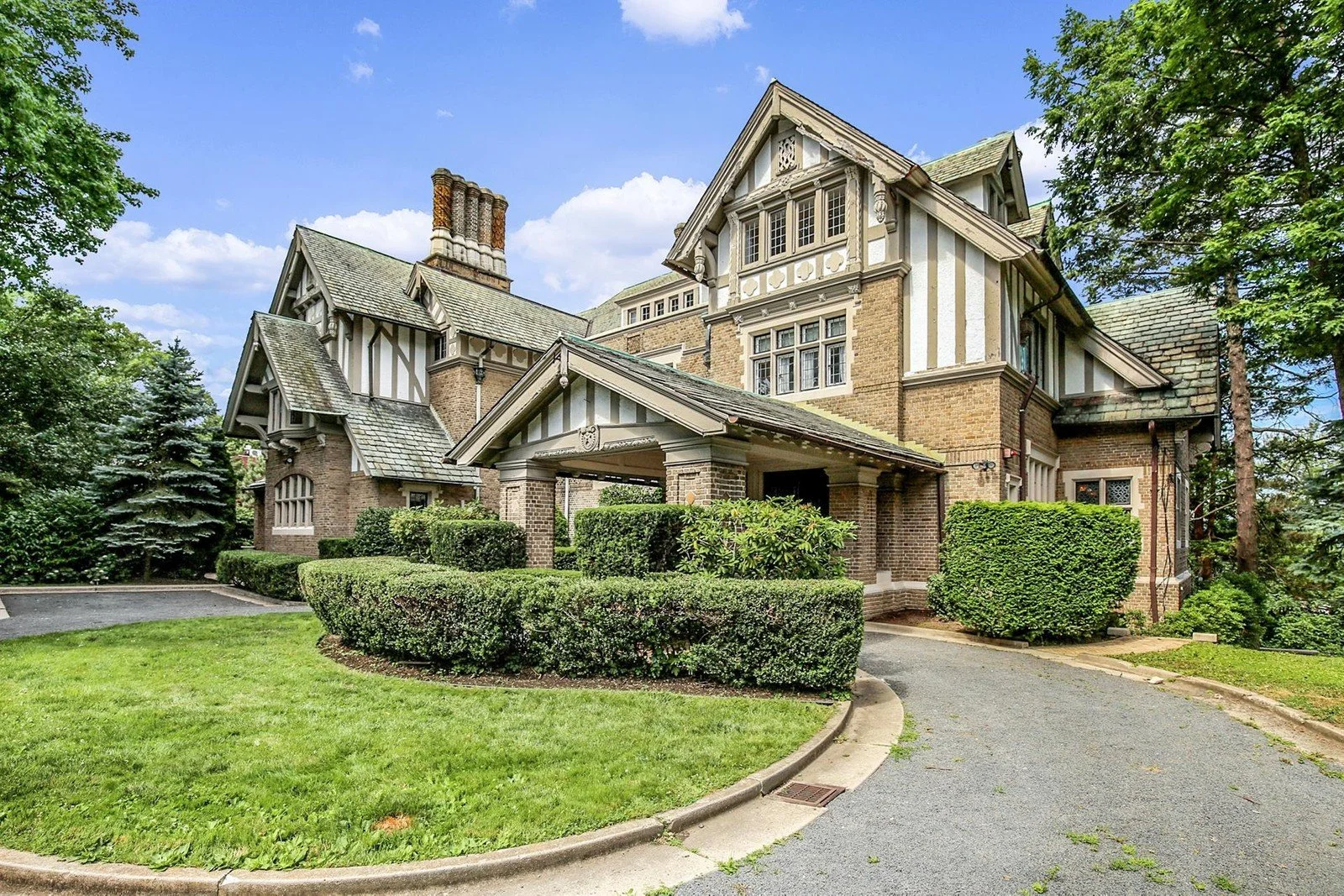
10 Beds | 7 Baths | 2 Half Baths | Single Family Home
PROPERTY DESCRIPTION
Unique opportunity to live in a grand, turn of the century, 3 story mansion with Hudson River views within 30 mins drive to Midtown. Built in 1914, this historic Park Hill home boasts a total of 12,000 sf on a manicured 1/2 acre w/ heated in-ground pool, terraces, covered patios, security gate and Porte Cochere circular driveway.
Retains all original details, formal receiving hall, grand staircase with wood-carved newel post and balusters, decorative lead glass windows, wood beamed ceilings, 10 fireplaces and wide plank floors. This 10-bedroom, 9-bathroom estate has been modernized for today's level of comfort. Updates; renovated gourmet kitchen, updated bathrooms and covered patio.
A truly impressive, one of a kind home that accommodates any extended family in comfort and offer the perfect setting for formal and informal entertaining.
Interesting History about Park Hill Funicular

Park Hill Elevator, Yonkers, N. Y.
I found a REALLY interesting article about the old funicular that used to run up Park Hill. (we live at the bottom of Park Hill) Not sure what a funicular is? Look it up here!
Our theory about our very large garage is that rich people who lived up Park Hill went to work using the old funicular and then would take the bus/tram/trolley/subway to NYC.
When the funicular closed down, people started driving down the hill. The people who lived at the bottom, realizing that rich people wanted a place to park, started putting up large garages all over the place. All along S. Broadway, there are old brick garage buildings. Our theory is that’s how we ended up with such a spacious garage. (Even a couple of blocks off of Broadway)
However, the article states that the funicular didn’t close down until 1937. And we theorize that our garage was built in the 1920’s. So perhaps the garages were the cause of the death of the funicular, rather than the other way around? Some more research is probably in order!
An interesting fact is that the funicular was designed by Otis Elevator, which was started in Yonkers in 1853 by Elisha Otis.
TWO YONKERS HOMES ARE THE ONLY REMNANTS OF A LOST FUNICULAR RAILWAY
NICHOLAS LOUD, UNTAPPED New York

Hidden amidst the slopes of the Park Hill neighborhood of Yonkers, New York are two houses that together serve as a unique piece of transportation history. The buildings at 32 Undercliff Street and 83 Alta Avenue sit on opposite ends of the large hill that gives the neighborhood its name (the former at the bottom, the latter at the top). They are each beautiful structures in their own right, but they were once inextricably linked by a funicular railway, one of the few to ever be constructed in the New York State.
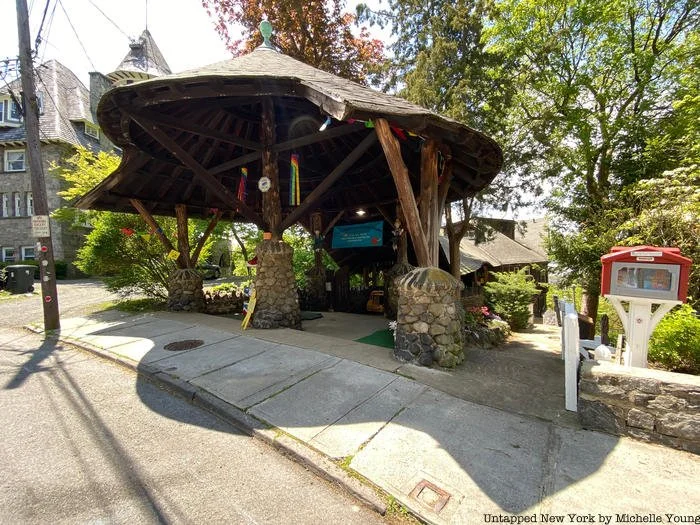
The top station of the funicular at 83 Alta Avenue is now a daycare
Funicular railroads (or to use the French spelling, funiculaire) are cable railways that use two counterbalanced passenger cars to travel up and down steep inclines. Famous examples include the Montmartre Funiculaire in Paris (hence the French) and the Monongahela Freight Incline in Pittsburgh (famous for being featured on Mr. Rogers’ Neighborhood). New York City even has one of its funiculars, a modern one inside the 34 Street-Hudson Yards subway station. The railways are engineering wonders, carrying passengers to and fro along precarious inclines, yet require intense upkeep in order to stay operational. 32 Undercliff Street and 83 Alta Avenue once acted as the station houses for the Park Hill Incline, a now defunct funicular railway that ran up and down the neighborhood’s mighty hill. In fact, these two houses are now the only physical evidence that the railway ever existed.

Overcliff, the home of Edwin Martin the president of the American Real Estate Company, is located just down the street from the 83 Alta Avenue end of the former funiclar (you can see it at the far right of the photograph)
While the Incline is no longer around, its story is closely entwined with that of the neighborhood it served. The Park Hill section of Yonkers was developed in 1888 by the American Real Estate Company of Manhattan. It is one of the earliest examples of aa planned community in the New York metropolitan area, conceived as an upscale locale for money-minded New Yorkers to make their own outside of the city’s limits. Atop the hill, the American Real Estate Company built large, European-esque structures meant to give the area an aristocratic flavor. These include the now demolished Hendric Hudson Hotel, designed by the same architect as the Château Frontenac in Quebec City and the Queen Anne-style mansion Overcliff, owned by Edwin Martin the president of the American Real Estate Company, which still stands.
In order to reach the hill’s top though, the Park Hill Incline was commissioned and opened in 1894. The bottom station of the Incline sat near the more modest commercial center of Yonkers and the other regional railroads that brought commuters from the city. From there, a single car carrying 10 passengers would embark on a 107-foot, 40-degree climb to the upper station house, delivering them to Park Hill proper. However, the Incline closed in 1937. If you were to visit its former location today, you would no longer be able to see any of its rails beneath the dense greenery the only remnants of the Incline are its former station houses, both of which have found new uses in the eighty years since.
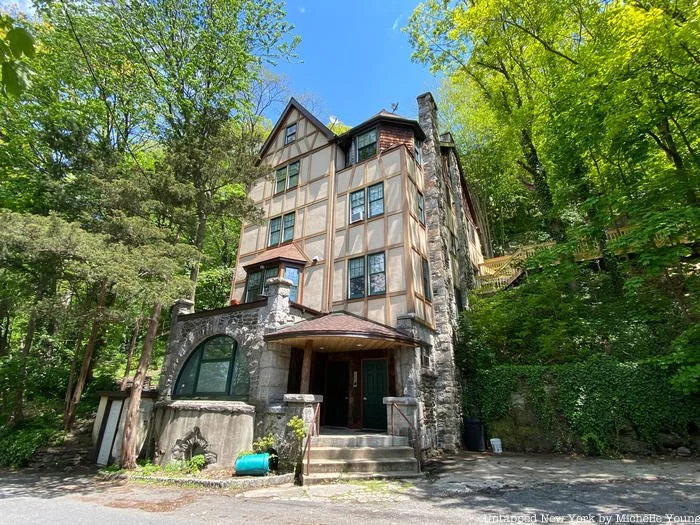
32 Undercliff Street, the former elevator house at the hill’s bottom, is the larger of the two structures, impressing passerby with five stories and a stone-and-stucco exterior. It once had a bit more Tudor-style details, as can be seen in the historic photograph on the Twitter account, Funimag. Today, the building holds apartments. At the hill’s top, the upper station house at 83 Alta Avenue, with its whimsical Alice in Wonderland-like design, has found a new use as a child care facility. Here, not only does the elevator house still exist set back from the street, the covered entrance and walkway can still be seen. While the link between these two structures has eroded physically over time, they are still connected by a common spirit of adaptability that could very well frame the larger story of Park Hill as it now sits.

While the neighborhood continues to boast impressive vistas of the Hudson and large Tudor-style homes, these grandiose structures are now complimented by smaller ranches and colonials that have since been constructed in the neighborhood (more on this neighborhood be found in an article from the New York Times). Despite Park Hill’s original ambition of being an A-lister getaway, it is now a relatively middle-class/upper middle-class neighborhood, with homes selling well below a million dollars and with residents only a short drive away from the shops and restaurants of Broadway down below.

The Park Hill Incline was an architectural feat, designed to whisk commuters away from downtown Yonkers and up into the fine homes of freshly-groomed Park Hill. While the rails and cables may be covered and gone, the old station houses have found new uses beyond transportation. Even without passenger cars climbing through the trees, Park Hill might be more closely connected with the rest of Yonkers than it ever has been before.
Park Hill, Yonkers, N.Y.: A ‘Secret Neighborhood’ Overlooking the Bronx

New York Times
Overlooking the Bronx Developed in the 19th century as a retreat for the wealthy, Park Hill is full of contrasts, with a mix of turreted mansions and modest postwar houses.
The land of Oz? Not quite — although there are yellow bricks peeking out from beneath the asphalt on Overcliff Street. “It’s like stumbling upon some secret neighborhood,” said Sandra Cardona, a vice president of a hotel company, who landed there in 2014 with her partner, Guillermo Garita, an architect.
Previously, the couple rented a loft in the financial district of Manhattan. But Ms. Cardona, who enjoys painting at home, was feeling cramped in her live-create situation. Familiar with Yonkers from a brief stint in a rental more than a decade before, she thought it might have what she was looking for. And it did, in the form of a 1929 red-brick house, with four bedrooms, two and a half bathrooms, hardwood floors and an unusual Georgian-meets-Tudor facade, that cost in the “low $700,000s,” she said.
The house, which the couple shares with their rescue dog, Zaha (as in the late architect Zaha Hadid), has plenty of room to spare, allowing Ms. Cardona to commandeer a bedroom for that long-sought dedicated space for art.